
1. Introduction: The Infinite Desire vs. The Finite Budget
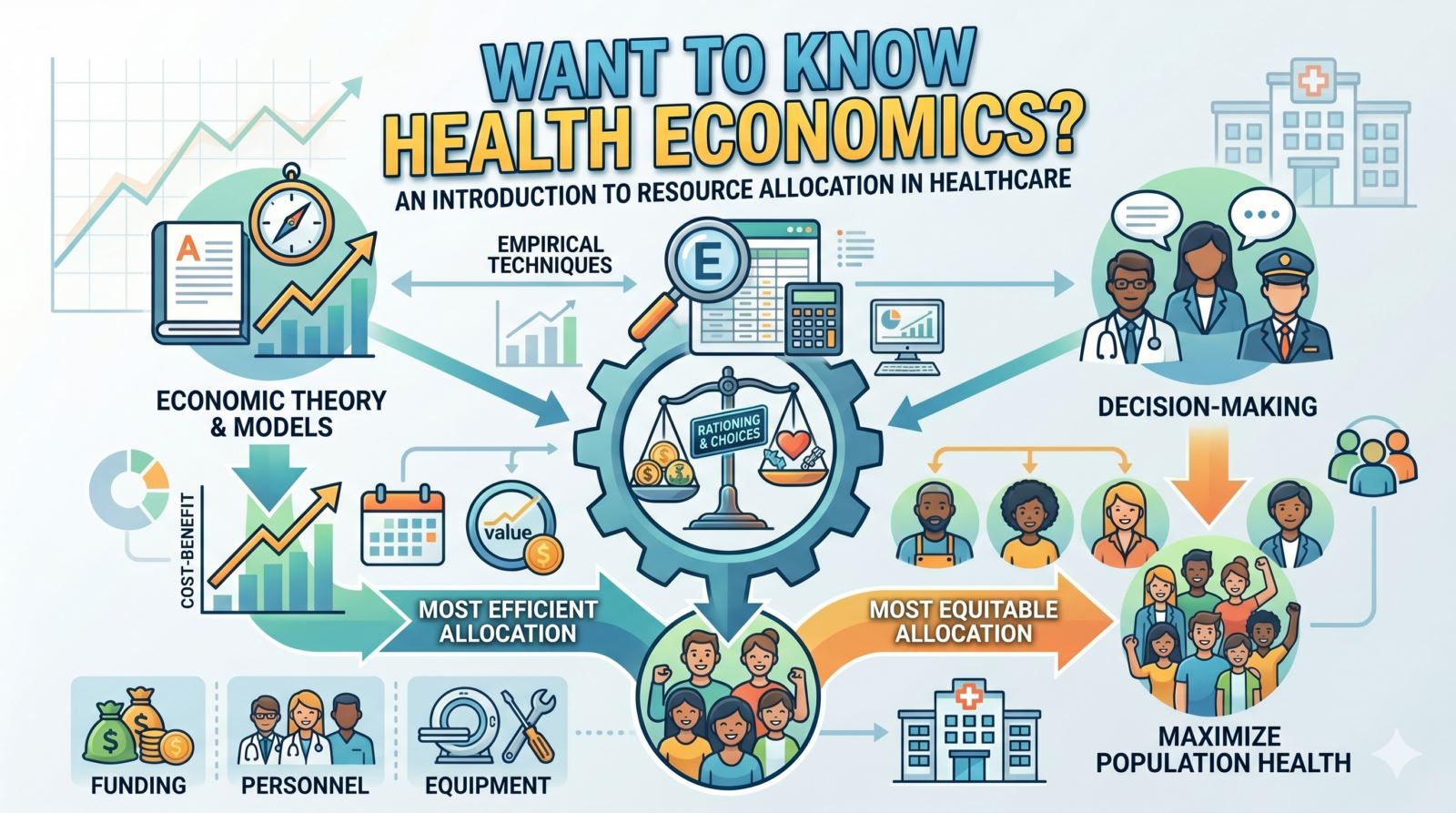
The human desire for longevity and vitality is essentially infinite, yet we occupy a world defined by the "dismal science" of scarcity. Health Economics is the discipline dedicated to navigating this tension, focusing on the allocation of limited resources to improve the health status of individuals and populations. Because land, labor, and capital are finite, society is forced into a constant state of rationing, whether through price or administrative design. This central problem reminds us that in the pursuit of well-being, we cannot have everything; we must choose.
2. Your Health Budget is Actually a Choice Between Hospitals and Schools
The most fundamental reality of public policy is that every investment carries an Opportunity Cost. Economists use the Production Possibilities Frontier (PPF) to map the maximum output of two competing goods, such as health and education. Moving along this frontier reveals that gaining 50 units of health might cost society 31 units of education. This trade-off is the silent engine of every state budget, proving that resources are fixed and gains in one sector necessitate sacrifices in another.
While market theory often suggests that private interest serves the public good, the delivery of health services rarely follows a simple, self-regulating path.
"Every individual necessarily labours to render the annual revenue of the society as great as he can... [he is] led by an invisible hand to promote an end which was no part of his intention." — Adam Smith, 1776
3. Healthcare is Only a Small Part of What Actually Keeps You Healthy
It is a common misconception that hospital beds and doctors are the primary drivers of longevity. In reality, the determinants of health status include a complex web of genetics, environment, income, education, and lifestyle. Access to medical care is merely one input into a much larger production function for "healthy time."
The World Health Organization (2015) highlights a counter-intuitive truth: our environment and social circumstances often have a greater impact on our well-being than medical interventions. This reality serves as a call to action for policy integration, suggesting that a dollar spent on housing or nutrition may save more lives than a dollar spent on clinical care. When we ignore these social determinants, we treat the symptoms of a society rather than the cause.
4. Why the "Free Market" Fails When We Get Sick
In a standard market, such as buying a hamburger, the consumer and seller share relatively equal information. However, the health market is defined by Asymmetric Information, where the physician possesses specialized knowledge that the patient cannot easily verify. This creates a unique Agency Relationship where we must trust the "supplier" to act in our best interest.
This imbalance often triggers Supplier Induced Demand, where providers may encourage more tests or procedures than are clinically necessary. Furthermore, the market faces the challenge of Moral Hazard, where individuals may take fewer health precautions or over-consume services because they do not face the full cost of their actions. These distortions mean a pure "free market" in healthcare can never reach an efficient equilibrium without intervention.
5. The Inverse Care Law—Why Markets Can’t Fix Fairness
Economists distinguish between Equality—giving everyone the same size "slice of the cake"—and Equity, which is fairness based on individual need. In a pure market, however, we inevitably encounter the "Inverse Care Law," where medical availability is lowest where the need is highest. This is compounded by Adverse Selection, where private insurers have a financial incentive to "poach" healthy customers and exclude those with expensive, chronic conditions.
"The force that creates and maintains the inverse care law is the operation of the market." — Hart, 1971
This structural failure reveals that the market treats health as a commodity for the wealthy rather than a necessity for the vulnerable. Addressing this requires us to look beyond simple efficiency and toward social justice.
6. The "Leaky Bucket" of Social Justice
Redistributing resources to achieve equity is rarely a perfect process, a concept famously described as Okun’s Leaky Bucket. The metaphor suggests that as we transfer wealth to support the vulnerable, some "leakage" or loss of efficiency occurs through administrative costs or reduced incentives. Because a perfect Pareto optimal state is almost impossible to reach in the real world, governments must often settle for a Second Best solution.
An example of a second-best strategy is New Zealand’s use of PHARMAC, which uses monopsony power to counter the monopoly power of pharmaceutical companies. By acknowledging these trade-offs, we move from chasing theoretical perfection to implementing pragmatic policies that maximize social welfare.
7. More Money Doesn't Always Buy More Years
International data proves that a high Gross Domestic Product (GDP) does not automatically translate into a healthy population. The United States is a significant outlier, spending more per capita on health than any other nation while failing to achieve a proportional increase in life expectancy. Conversely, New Zealand performs remarkably well, ranking 11th in life expectancy among 39 nations despite being only 20th in expenditure.
This disparity reveals the heartbreaking reality of systemic inefficiency and the importance of the Inverse Care Law. In the case of the Russian economy, a market-driven approach has left those in the greatest need least able to access care, suppressing national health outcomes despite spending. These examples show that the value of a health system is measured by its reach and equity, not just its price tag.
8. Conclusion: The Question of Value
Ultimately, health economics is not about "saving money" but about "maximizing value" for society. By understanding market failures and the social determinants of health, we can shift our focus from medical consumption to genuine well-being. We must leave ourselves with a provocative challenge to our current public priorities:
If we know that income and education impact our health more than a hospital visit, why do we keep focusing our budgets on the doctor’s office?